Cost-Benefit Analysis#
In this example, we develop a stylised example template for Cost-benefit Analysis (CBA).
CBA involves prior estimation of the Expected Annnual direct Damages (EAD) and Expected Annual indirect Economic Losses (EAEL) with and without the implementation of an adaptation option. These losses are estimated over a set of consecutive years or in most cases at specific time horizons. For example - EAD and EAEL might be estimated for a given baseline year (e.g. 2025) and for future years for which climate scenario-based hazard maps might be created (e.g. 2050, 2080 SSP3 7.0).
CBA also requires inputs of the initial investment costs of the adaptation option, and its maintenance costs (recurrent and periodic).
Further inputs include the timeline of the CBA assessment and discount rates. Economic GPD growth rates might also be needed to project future EAELs.
The outputs of this analysis are the benefits (avoided damages and losses over time), the costs and the Benefit-Cost Ratio (BCR).
import os
from pathlib import Path
import pandas as pd
import numpy as np
import warnings
import matplotlib.pyplot as plt
from cba.cba_functions import *

warnings.simplefilter("ignore")
base_path = Path(os.path.dirname(os.getcwd()) + "/data")
outpath = Path(os.path.dirname(os.getcwd()) + "/output")
1. Setup and Data Acquisition#
Read CBA model parameters#
loss_id_column = "id"
dimension_column = "length"
loss_columns = ["EAD", "EAEL"]
cost_columns = ["initial_investment", "periodic_maintenance", "recurrent_maintenance"]
year_column = "year"
options_columns = ["option", "hazard"]
parameter_df = pd.read_csv(base_path / "cba_parameters.csv")
parameters = parameter_df.set_index("parameter").to_dict()["value"]
st_y = int(parameters["start_year"])
en_y = int(parameters["end_year"])
d_r = float(parameters["discount_rate"])
apply_gdp_series = parameters["apply_gdp_timeseries"]
apply_gdp_fixed_rate = parameters["apply_fixed_gdp_growth"]
gdp_r = float(parameters["gdp_rate"])
timeseries = np.arange(st_y, en_y + 1, 1)
Read damages and losses without adaptation and convert to timeseries#
noadapt_df = pd.read_csv(base_path / "without_adaptation_losses.csv")
noadapt_df = estimate_risk_time_series(
    noadapt_df, ["hazard"], loss_columns, "year", st_y, en_y
)
Read damages and losses with adaptation and convert to timeseries#
adapt_df = pd.read_csv(base_path / "with_adaptation_losses.csv")
adapt_df = estimate_risk_time_series(
    adapt_df, ["hazard", "option"], loss_columns, "year", st_y, en_y
)
Merge the loss DataFrames and estimate avoided losses#
noadapt_df.rename(
    columns=dict([(lc, f"{lc}_noadapt") for lc in loss_columns]), inplace=True
)
adapt_df.rename(
    columns=dict([(lc, f"{lc}_adapt") for lc in loss_columns]), inplace=True
)
n_idx_cols = [c for c in noadapt_df.columns.values.tolist() if c not in loss_columns]
a_idx_cols = [c for c in adapt_df.columns.values.tolist() if c not in loss_columns]

adapt_df = pd.merge(
    adapt_df, noadapt_df, how="left", on=list(set(a_idx_cols).intersection(n_idx_cols))
)
for lc in loss_columns:
    adapt_df[f"avoided_{lc}"] = adapt_df[f"{lc}_noadapt"] - adapt_df[f"{lc}_adapt"]
2. Economic Loss Analysis#
Project the Avoided Economic losses by some GDP change factor, if needed#
gr_f = []
if apply_gdp_series == "TRUE":
    gr_f = pd.read_csv(base_path / "gdp_timeseries.csv")
    gr_f = list(gr_f.itertuples(index=False, name=None))
    gr_f = calculate_growth_rate_factor(gr_f, st_y, en_y)
elif apply_gdp_fixed_rate == "TRUE":
    gr_f = calculate_growth_rate_factor(gdp_r, st_y, en_y)

if len(gr_f) > 0:
    gr_f = pd.DataFrame(gr_f, columns=[year_column, "gdp_factor"])
    adapt_df = pd.merge(adapt_df, gr_f, how="left", on=[year_column])
    adapt_df["avoided_EAEL"] = adapt_df["avoided_EAEL"] * adapt_df["gdp_factor"]
    adapt_df.drop("gdp_factor", axis=1, inplace=True)
3. Cost-Benefit Calculation#
Estimate the adaptation cost timeseries#
cost_df = pd.read_csv(base_path / "adaptation_options_and_costs.csv")
cost_df = estimate_adaptation_cost_time_series(
    cost_df, ["option", "hazard", "adapt_cost_uom"], start_year=st_y, end_year=en_y
)
Merge the adaptation losses with the adaptation costs to estimate the benefits and cost#
adapt_df = pd.merge(
    adapt_df, cost_df, how="left", on=options_columns + [year_column]
).fillna(0)
adapt_df["benefit"] = adapt_df[[f"avoided_{lc}" for lc in loss_columns]].sum(axis=1)
adapt_df["cost"] = adapt_df[cost_columns].sum(axis=1)
adapt_df["cost"] = adapt_df["cost"] * adapt_df[dimension_column]
Do the discounting of the benefits and the costs based on the discount rate#
dis_series = calculate_discounting_rate_factor(
    discount_rate=d_r, start_year=st_y, end_year=en_y, maintain_period=1.0
)
dis_df = pd.DataFrame(
    list(zip(timeseries, dis_series)), columns=[year_column, "discount_rate"]
)
adapt_df = pd.merge(adapt_df, dis_df, how="left", on=[year_column])
adapt_df["benefit_pv"] = adapt_df["benefit"] * adapt_df["discount_rate"]
adapt_df["cost_pv"] = adapt_df["cost"] * adapt_df["discount_rate"]
4. Synthesis and Results#
Estimate the added benefits, costs, and BCR summed over the timeseries#
sum_columns = ["benefit", "cost", "benefit_pv", "cost_pv"]
df = (
    adapt_df.groupby([loss_id_column] + options_columns)
    .agg(dict([(c, "sum") for c in sum_columns]))
    .reset_index()
)
df["BCR"] = df["benefit_pv"] / df["cost_pv"]
df
| id | option | hazard | benefit | cost | benefit_pv | cost_pv | BCR | |
|---|---|---|---|---|---|---|---|---|
| 0 | 1 | flood wall | flood | 32627.951377 | 4875.0 | 9335.697257 | 2863.302085 | 3.260465 |
| 1 | 1 | swales | flood | 20718.844610 | 1625.0 | 5949.529544 | 954.434028 | 6.233568 |
| 2 | 2 | flood wall | flood | 2238.576048 | 975.0 | 660.842549 | 572.660417 | 1.153987 |
| 3 | 2 | swales | flood | 809.483236 | 325.0 | 254.502424 | 190.886806 | 1.333264 |
Save the final results#
df.to_csv(outpath / "CBA_result.csv", index=False)
5. Validation and Visualisation#
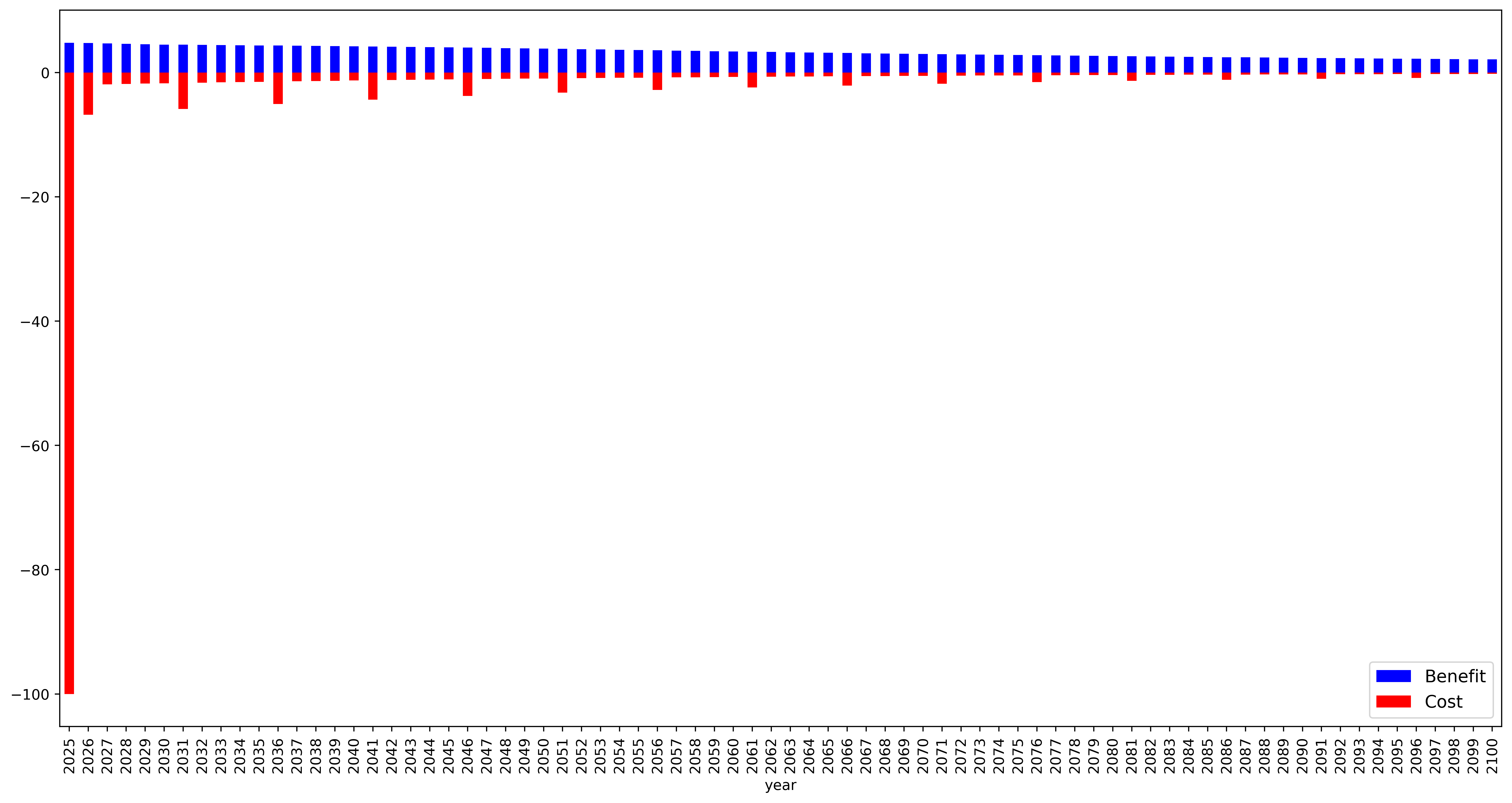
Test - Plot of Benefit and Cost timeseries with or without discounting#
fig, ax = plt.subplots(1, 1, figsize=(18, 9), dpi=500)
test_df = adapt_df[(adapt_df["id"] == 2) & (adapt_df["option"] == "swales")]
test_df["cost"] = -1.0 * test_df["cost"]
test_df.plot.bar(ax=ax, x=year_column, y="benefit", color="b")
test_df.plot.bar(ax=ax, x=year_column, y="cost", color="r")
ax.legend(["Benefit", "Cost"], loc="lower right", fontsize=12)
<matplotlib.legend.Legend at 0x15c4dba90>
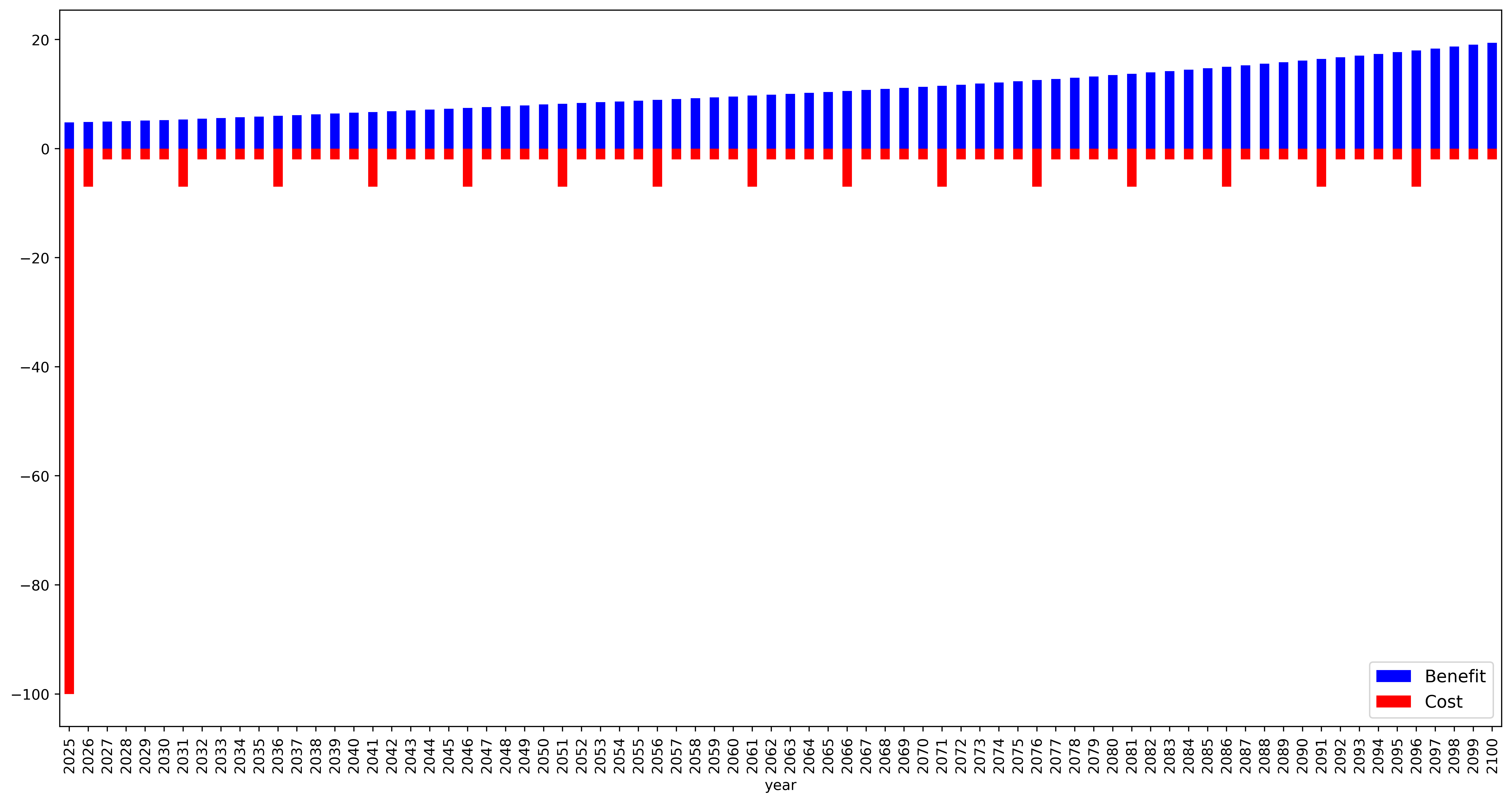
fig, ax = plt.subplots(1, 1, figsize=(18, 9), dpi=500)
test_df = adapt_df[(adapt_df["id"] == 2) & (adapt_df["option"] == "swales")]
test_df["cost_pv"] = -1.0 * test_df["cost_pv"]
test_df.plot.bar(ax=ax, x=year_column, y="benefit_pv", color="b")
test_df.plot.bar(ax=ax, x=year_column, y="cost_pv", color="r")
ax.legend(["Benefit", "Cost"], loc="lower right", fontsize=12)
<matplotlib.legend.Legend at 0x15cf5b460>